
OpenAI has since fixed the bug. This blip is still worth understanding, because it shows how fragile AI referral data is, and because ChatGPT now links to websites far more often than it did a month ago.
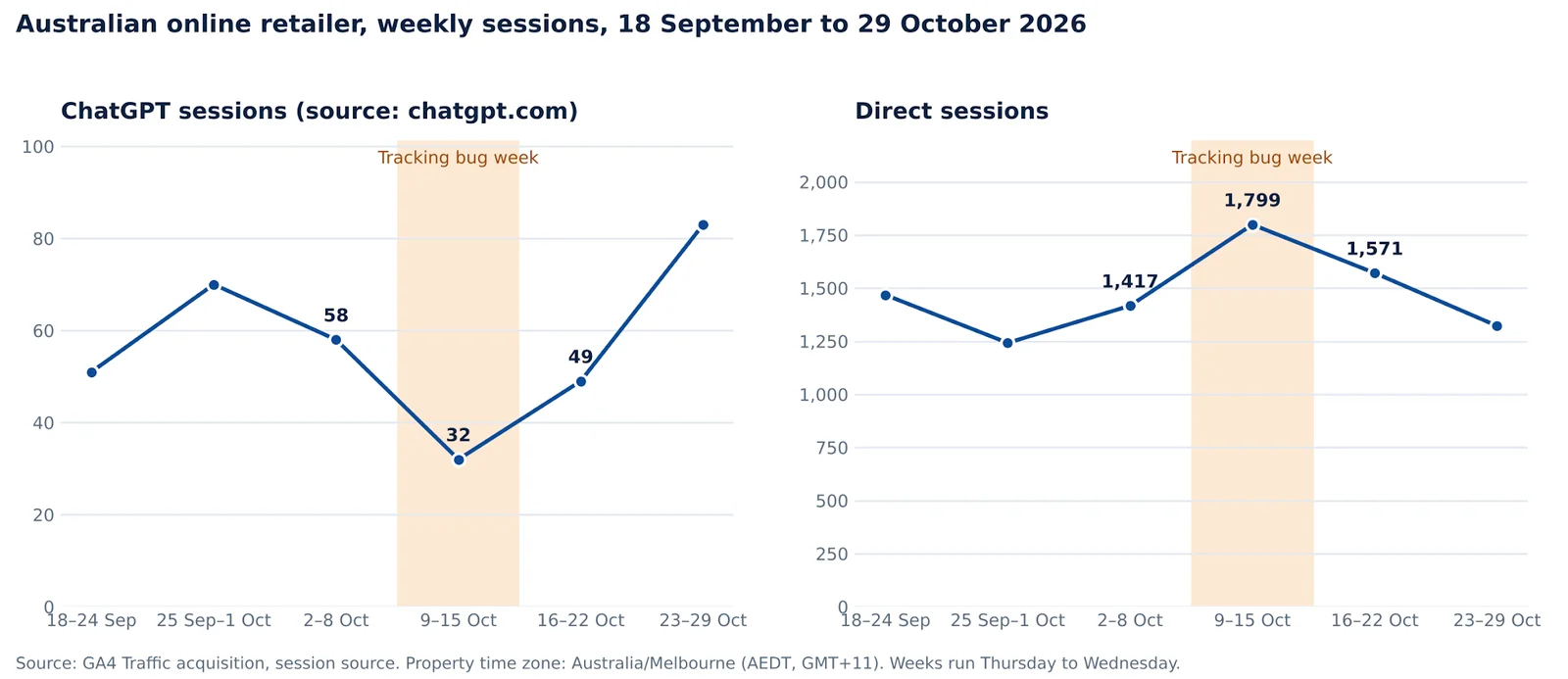
I checked four of my client accounts across ecommerce, local services and education. The clearest result came from an Australian online retailer, where ChatGPT sessions fell 45% in the week of 9 October (58 to 32) while total sessions held steady at around 14,300. Once the fix rolled out, they recovered to 49 the following week. In the other three accounts, ChatGPT sent fewer than 20 sessions a week, so a drop of this size was hard to separate from normal week-to-week movement. That is part of the problem: unless ChatGPT already sends meaningful traffic, a tracking change like this can go unnoticed.
Why GA4 started counting ChatGPT visits as Direct
GPT-6 reached paid ChatGPT plans on 7 October and free plans on 8 October. Its new answer layout, which OpenAI calls Intelligent UI, opened links in a new tab with the referrer withheld, and inline links lost the utm_source=chatgpt.com tag ChatGPT had been adding since mid-year. However, links in the sources panel and shopping results kept the tag.
With no tag and no referrer, GA4 can't attribute a visit to ChatGPT, so it files it as Direct. Several analytics vendors saw the result within days:
- LLM Pulse: ChatGPT sessions down about 46% across its monitored sites from 9 to 11 October, while total traffic stayed roughly flat and Perplexity and Claude referrals didn't move
- Graphite: ChatGPT-attributed sessions down 22% to 57% from 9 October.
- Profound: the share of cited ChatGPT answers with at least one tagged link fell from about 98% on 8 October to 66% on 14 October
Adobe's Cedric Huesler produced the most direct evidence. On about 500 pages where ChatGPT had supplied at least 5% of visits, he compared 9 to 13 October with the previous week. ChatGPT visits fell by roughly 31,000 a day and Direct visits on the same pages rose by roughly 26,000 a day.
Huesler says OpenAI confirmed the bug to him on 14 October and began rolling out a fix early on 15 October, US time. By that morning, tagged ChatGPT clicks across the domains he tracks were back to 95–100% of the previous week's level. OpenAI hasn't said anything publicly, and its release notes don't mention it.
The fix restored the tag, not the referrer, which is still missing from most ChatGPT clicks. Visits already recorded as Direct won't be reclassified. For Australian GA4 property, the affected window starts on 9 October because of the time difference.
More links in ChatGPT answers complicate the picture
Peec AI's Tomek Rudzki ran the same 1 million prompts through ChatGPT before and after GPT-6. The share of answers with a direct link to a webpage went from 8–10% to 42%, and 54% of those links went to a homepage.
That measures links shown, not clicks, and Peec AI sells AI visibility tracking, as do most of the vendors quoted here. Even allowing for that, a fourfold jump in linked answers is significant for any business that gets named in ChatGPT.
Consider a visitor who finds a Melbourne electrician through ChatGPT and clicks through to the business website. Without a tag or referrer, that visit is attributed to Direct in GA4. Whether the visitor then makes an enquiry is a separate measurement problem.
Gemini has its own quirks. It started adding UTM parameters in early October, and LLM Pulse saw Gemini-tagged visits shift around the same time in a way that looked like a tagging change rather than a real drop. Each platform handles links differently, and none of them announce changes.
Check whether the traffic moved channels
This takes about half an hour in GA4.
- Annotate the window. Mark 9 to 15 October (Australian time) so nobody compares that week with others later.
- List your top ChatGPT landing pages. Filter session source to chatgpt.com for the four weeks before 8 October and note the ten pages with the most sessions.
- Compare ChatGPT and Direct on those pages for the week before and the week of the bug. If ChatGPT fell and Direct rose by a similar amount, that's a strong indication the traffic was misattributed.
- Check the homepage separately, since most of ChatGPT's new links point there.
- Check total sessions and enquiries. If total sessions and enquiries remained steady, that supports the possibility of a tracking issue rather than a genuine decline in traffic.
- Count the tag, not the referrer. Your AI channel grouping should match utm_source=chatgpt.com as well as the chatgpt.com referrer. Set up the same for Gemini, Perplexity and Copilot.
- Leave ChatGPT Ads alone. UTM parameters you add to your own ad links weren't affected
The difference between lost ChatGPT sessions and extra Direct sessions is a rough estimate of what was mislabelled. Direct is usually much larger than ChatGPT, so small shifts can be hard to see. In the retailer's account, ChatGPT lost 26 sessions in the bug week while Direct gained 382. Most of that Direct increase came from something else, and a shift of 26 sessions is easy to miss inside a channel of 1,800.
What a referral report cannot tell you
The October incident is a reminder that attribution depends on how each platform handles outbound links. A change to those links can look like a change in demand, even when the number of visitors has barely moved.
This is where it gets hard for service businesses. GA4 only sees the website visit. It doesn't see the phone call, the quote sent a week later or the job that closed a month after that, so a ChatGPT visit that turned into a $20,000 contract looks the same as one that bounced.
To measure AI search properly:
- Record the channel, landing page and UTM tags on every form submission and tracked call.
- Keep that source attached to the lead until it becomes a sale, so revenue can be traced back.
- Track mentions and citations in AI answers separately from clicks, since more answers now resolve without one.
I built LeadSight to connect marketing enquiries with their eventual sales data, so I can report on the revenue attributed to each channel. It still relies on accurate source data coming in, which is exactly why tracking changes like this matter. If you'd like me to look at what AI search is doing for your business, get in touch.
It happens in my own business too. An ecommerce clothing brand found me through ChatGPT and got in touch about SEO. After a discovery call, I put together an SEO audit and growth strategy for him, and the deal closed a week later. A lead like that is easy to miss if the first visit lands in Direct.